It’s Spooky Season, so you know I’m going to be talking about ghosts. Believe it or not, this is one ghost pretty much everyone has seen. It’s a pretty well known fact that since ancient times people have believed that the spirits of the dead could return to the world of the living, yet their descriptions vary widely. I’ve even had my own experience with what might have been a spirit presence one December evening several years ago, which I described then as a formless mist drifting through the air. Before this, I thought that a ghost would look something like Marley’s ghost in Charles Dicken’s classic story: A Christmas Carol. Marley’s ghost was pale and gaunt with eyes like black holes that see nothing, with a cavernous mouth hanging open in a silent scream. But surprisingly one of the most common ways to portray a ghost is something a bit more mundane and even comical; that is of a flowing white sheet with holes for eyes and mouth. Yes we are all pretty familiar with this sort of ghost. We may have even dressed up as one for Halloween ourselves at some point in our lives or had friends who did and of course we still see trick or treaters dressed this way now.
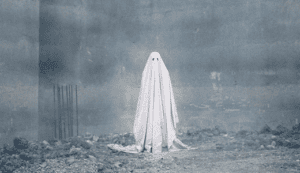 Yet this isn’t a modern phenomenon. Shrouded figures became a common way of depicting spirits as early as the Middle Ages. Over the years, the shroud evolved into this “sheet” ghost, eventually reaching iconic status as a well-known symbol of the supernatural. By the 1900s, white fabric covering along to depict a ghost was a familiar symbol in theatrical productions. Sheet-garbed ghosts have been painted by artists and described by writers the world over, this likeness becoming so widespread that most of us recognize it instantly. But how did ghosts come to be represented this way?
The most likely source for our sheet-wearing ghosts dates back to past funerary traditions and how the deceased were dressed for burial, but could also include ancient spiritual beliefs and folklore. While in modern times, coffins are more often used to bury the dead, in the past the deceased were sometimes laid to rest in shrouds made of thin fabric draped over their bodies; without a coffin. These burial cloths were usually white to symbolize the heavenly world and purity. Ghosts were often felt to be messengers from the hereafter and people often described them as wearing burial shrouds, making the connection between spirit and corpse. In wealthy families, these shrouds were often quite elaborate and made of fine cloth. Less affluent families had to use what was available; the sheet from the deathbed, thus the sheet ghost was born…sort of.
In folklore, ghosts were often described as pale spectral forms devoid of color. Death itself has become synonymous with the color white and paleness, symbolic of the afterlife and the soul. Imagine a ghost rising from the grave, and it is likely you would picture it wearing a white shroud. Theatrical plays in the 1800s furthered the symbolism with their ghost characters costumed in white sheets. It wasn’t long before audiences came to expect that a “real” ghost would probably look the same. Dickens reinforced this motif in his stories, often describing ghosts in flowing white clothing or shrouds. As the tradition grew in popularity in the United Kingdom then spread to the United States, the sheet ghost soon became a part of our Halloween culture. 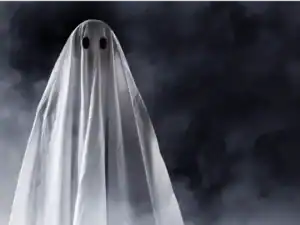
The spiritualist movement popular in the late 1800s also furthered the idea that ghosts wore white sheets, especially when it was profitable. Séances were extremely popular at the time and some professing to be mediums would combine theatrics, trickery as well as donning flowing white fabrics to imitate the spirits of the dead. Under the eerie lighting effects, darkness and mysterious atmosphere they created, it wouldn’t be difficult for the participants to be fooled by a person wearing a white sheet. It wasn’t long before unscrupulous spirit photographers also picked up on this idea to trick people. By using double exposures or other deceptive methods, they purportedly took photos of “ghosts” haunting people.
Starting around the late 1900’s being a ghost for Halloween became increasingly popular with the public. The costume was easy to make and economical with sheets being relatively inexpensive and readily available. One could probably see a myriad of ghosts back then, short, tall and anything in between going about their hauntings on Halloween night. Halloween evolved into more of a children’s holiday sometime during the Great Depression years, with trick-or-treating of course being the highlight. I mean of course; who doesn’t like free candy?
However more recently Halloween has seemed to have taken on a life of its own and “Spooky Season” seems to start as soon as the first leaf falls, and it’s not just for children anymore. Now many adults get into the holiday spirit as well; taking part in a variety of halloween themed events, parties, watching scary movies, and of course visiting one of the myriad of “haunted houses” that crop up seemingly overnight. The traditional bedsheet ghost would transform from frightening to funny in the early 20th century, in no small part to children’s cartoons. One very popular animated feature was the comical Lonesome Ghosts released by RKO Radio Pictures on Christmas Eve, 1937. I remember watching this back in the 1960s and it is still widely available for viewing. I might have to put it on my Halloween movie bucket list.
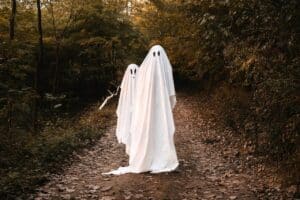 While the idea that ghosts run around wearing the laundry now seems pretty silly, one can understand the element of mystery it once held and still might. The sheet-draped “ghost” may play into how our minds work when we are faced with the unknown. That’s when our imagination kicks in to fill in the blanks. If you’ve ever walked into a pitch dark room or ventured down a deserted country road alone on a moonless night; what you imagine could be lurking there is often more frightening than the reality. As someone who has done a good bit of research into what ghosts are supposed to look like, they’ve been described to me as apparitions, mists, shadows, or flickers of light; but never one who took a fashion risk by wearing a bedsheet. Talk about a fashion faux pau! The sheet ghost, while popular as a Halloween icon or movie trope, has no more paranormal truth than it has ectoplasm. So I think I can say with a good deal of certainty that real ghosts do not wear white sheets.
Perhaps though, the sheet ghost speaks to ancient archetypes deep within our collective unconscious that still remembers the burial practices, stories, and folklore of our ancestors. Thus attaching a physical form to something unseen may make it seem less frightening, quieting our subconscious fears of the dead returning. Thus, the sheet ghost will probably continue to “haunt” us. So if you happen to see one of these “white-sheet” ghosts this Halloween, will you really know what lies underneath?
If you would like to read about my personal ghost experience, be sure to pick up my book, Haunted Newaygo available through Arcadia Publishing or if you’d like a signed copy, drop me an email or go to my facebook page, the M-Files.
Sources:
“A Christmas Carol: In prose. Being a ghost story of Christmas.” Edited September 24, 2026. Wikipedia. https://en.wikipedia.org/wiki/A_Christmas_Carol Accessed October 20, 2026.
Bennington-Castro, Joseph. “Why do we picture ghosts wearing white sheets?” Middle Ages. History.com. September 26, 2026. https://www.history.com/articles/ghosts-white-sheets-costume?utm_placement=newsletter Accessed October 11, 2026.
Denisa, K. “Why ghosts are depicted as white sheets: The history and symbolism.” Chi-nese.com Updated September 30, 2025. https://chi-nese.com/why-do-ghosts-look-like-sheets/ Accessed October 11, 2026.
“Lonesome Ghosts.” Wikipedia. Last edited August 17, 2026. https://en.wikipedia.org/wiki/Lonesome_Ghosts. Accessed October 20, 2026.
Thank you for watching the Muskegon Channel. See you next time on Paranormal Muskegon.
Have a paranormal story you would like to hear, share or know someone has had a paranormal experience, unusual ability, or other inexplicable involvement with the unknown, contact me at mariehelena777@gmail.com or on facebook: www.facebook.com/paranormalmuskegon.
To read more about some of Muskegon’s haunted history; check out my book: Haunted Muskegon – Arcadia Publishing or Haunted Newaygo County also through Arcadia Publishing for more local Michigan ghost stories.